
Objective: To evaluate the effects of glucagon-like peptide-1 receptor agonists (GLP-1RAs) on alcohol-related outcomes in adults with or without alcohol use disorder (AUD).Methods: A systematic review and meta-analysis following PRISMA guidelines searched PubMed, Embase, and Cochrane Library up to May 3, 2025. Eligible studies included randomized controlled trials (RCTs) and observational studies assessing GLP-1RAs (e.g.,… Continue reading The effects of glucagon-like peptide-1 receptor agonists (#GLP1-RAs ) on #alcohol -related outcomes: a systematic review and meta-analysis
Tag: Alcohol
Alcohol’s Effects on the Lung and Lung Disease
Purpose: Alcohol misuse is widely accepted as an independent risk factor for a wide variety of lung diseases, such as pneumonia and acute respiratory distress syndrome. Alcohol induces changes in the regulatory mechanisms of the lung, both at a mechanical and immunological level. Understanding these changes might help discover new targets for drugs and therapeutic… Continue reading Alcohol’s Effects on the Lung and Lung Disease
Association Between #Alcohol Consumption, #Cognitive Abilities, and Neuropathologic Changes
Background and ObjectivesHeavy alcohol consumption is a major global health concern linked to increased morbidity and mortality. However, the long-term impact of excessive alcohol consumption on cognitive abilities and dementia-related neuropathology is unclear. The aim of this study was to analyze the association between alcohol consumption and age-related neuropathologic outcomes in a population-based autopsy study.MethodsThis… Continue reading Association Between #Alcohol Consumption, #Cognitive Abilities, and Neuropathologic Changes
Real-Time Assessment of #Alcohol Reward, Stimulation, and Negative Affect in Individuals With and Without Alcohol Use Disorder and #Depressive Disorders
Objective:The allostasis theory states that, as addiction develops, alcohol is consumed to relieve negative affect rather than to produce positive effects. This study aimed to investigate the real-time subjective effects of alcohol in individuals with alcohol use disorder (AUD) and those prone to negative affect by virtue of having comorbid depressive disorder (DEP).Methods:Participants (N=221) completed… Continue reading Real-Time Assessment of #Alcohol Reward, Stimulation, and Negative Affect in Individuals With and Without Alcohol Use Disorder and #Depressive Disorders
ACG Clinical Guideline: #Alcohol-Associated #Liver Disease
Alcohol-associated liver disease (ALD) is the most common cause of advanced hepatic disease and frequent indication for liver transplantation worldwide. With harmful alcohol use as the primary risk factor, increasing alcohol use over the past decade has resulted in rapid growth of the ALD-related healthcare burden. The spectrum of ALD ranges from early asymptomatic liver… Continue reading ACG Clinical Guideline: #Alcohol-Associated #Liver Disease
#Smoking and #Alcohol Consumption and Risk of Incident #Diverticulitis in Women
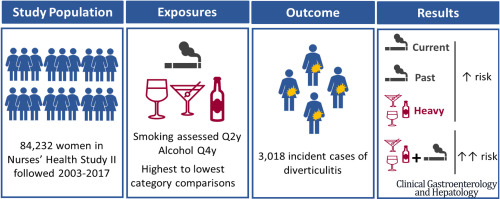
Much of what is known about the effects of alcohol and tobacco use on diverticular disease derives from studies of asymptomatic diverticulosis or complicated diverticulitis. We examined smoking and alcohol consumption and risk of incident diverticulitis in a large cohort of women.MethodsWe conducted a prospective study of 84,232 women in the Nurses’ Health Study II… Continue reading #Smoking and #Alcohol Consumption and Risk of Incident #Diverticulitis in Women
Semaglutide reduces alcohol intake and relapse-like drinking in male and female rats
BackgroundGlucagon-like peptide1 receptor (GLP-1R) agonists have been found to reduce alcohol drinking in rodents and overweight patients with alcohol use disorder (AUD). However, the probability of low semaglutide doses, an agonist with higher potency and affinity for GLP-1R, to attenuate alcohol-related responses in rodents and the underlying neuronal mechanisms is unknown.MethodsIn the intermittent access model,… Continue reading Semaglutide reduces alcohol intake and relapse-like drinking in male and female rats
Non-heavy alcohol use associates with liver fibrosis and ‘nonalcoholic’ steatohepatitis in the Framingham Heart Study
Background and AimsWhile heavy alcohol use consistently associates with liver disease, the effects of non-heavy alcohol consumption are less understood. We aimed to investigate the relationship between non-heavy alcohol use and chronic liver disease.MethodsThis cross-sectional study included 2629 current drinkers in the Framingham Heart Study who completed alcohol use questionnaires and transient elastography. We defined… Continue reading Non-heavy alcohol use associates with liver fibrosis and ‘nonalcoholic’ steatohepatitis in the Framingham Heart Study
Spironolactone as a potential new pharmacotherapy for alcohol use disorder: convergent evidence from rodent and human studies
Evidence suggests that spironolactone, a nonselective mineralocorticoid receptor (MR) antagonist, modulates alcohol seeking and consumption. Therefore, spironolactone may represent a novel pharmacotherapy for alcohol use disorder (AUD). In this study, we tested the effects of spironolactone in a mouse model of alcohol drinking (drinking-in-the-dark) and in a rat model of alcohol dependence (vapor exposure). We… Continue reading Spironolactone as a potential new pharmacotherapy for alcohol use disorder: convergent evidence from rodent and human studies
 2 Medical News